

Bringing you the latest news on media and advertising
Provided by AGP
As President Trump meets Xi Jinping in Beijing, a new report warns Washington against trading away the US auto industry
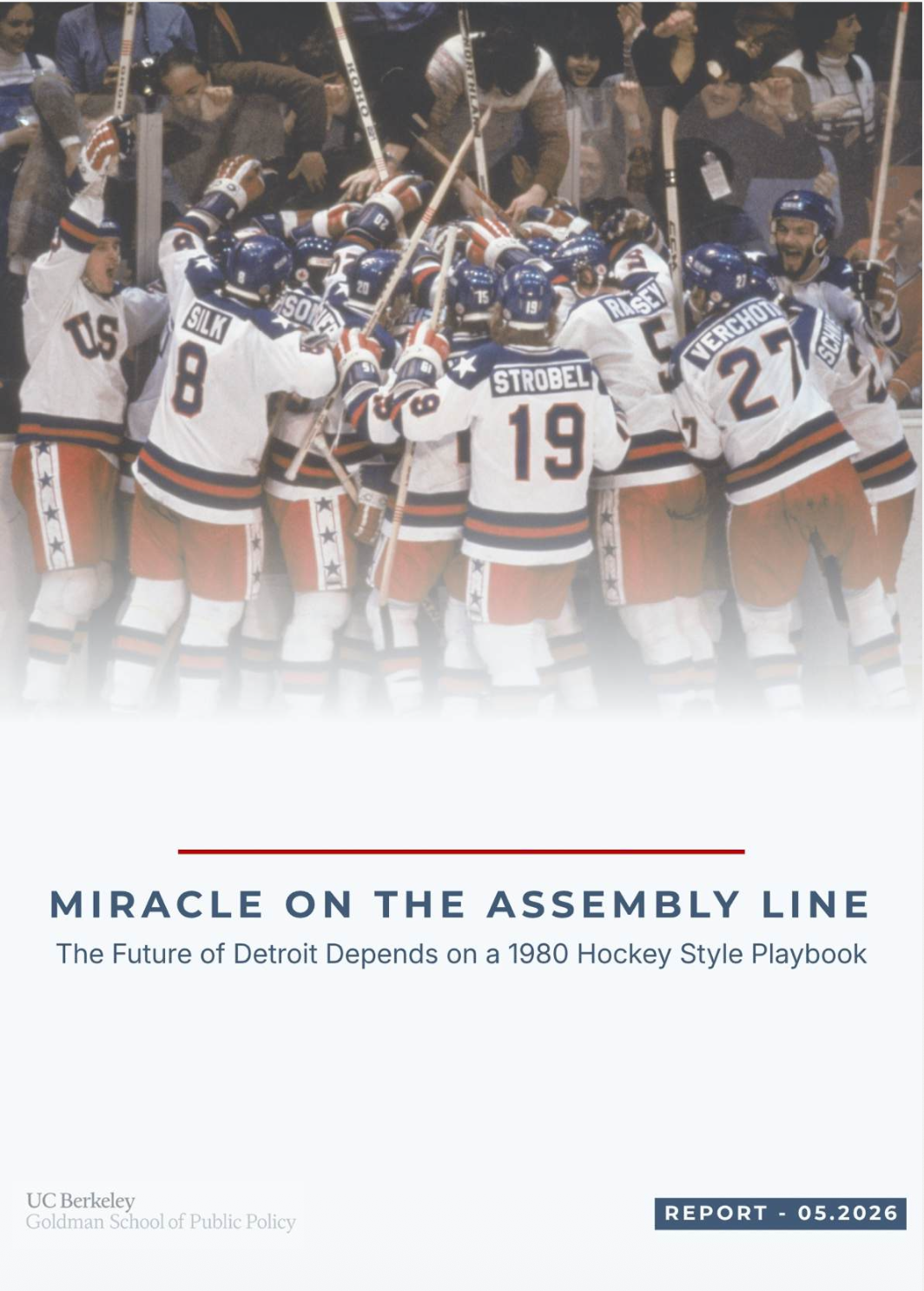
Miracle on the Assembly Line report cover
Berkeley modeling shows allowing Chinese car companies into the US market would cost 99,000 jobs. However, a new game plan creates 1.46M jobs and saves Detroit.
The worst outcome from this summit would be granting Chinese automakers access to the US market in exchange for short-term wins. It would cost 99,000 American jobs and hand China the transport future.”
BERKELEY, CA, UNITED STATES, May 13, 2026 /EINPresswire.com/ -- A new report from the Center for Environmental Public Policy (CEPP) at UC Berkeley warns that the American auto industry is entering the third period of a fiercely contested global EV transition, far behind disciplined, state-backed Chinese competitors flooding global markets with affordable electric vehicles (EVs). — Harry Martin
Using the lessons from ‘the Miracle on Ice’ win at the 1980 Lake Placid Olympics, the report cautions that unless US policymakers urgently throw out their old industrial playbook—just as Team USA did against the Soviets—the nation risks losing the most important transportation technology of the 21st century to a strategic rival.
Bolstered by significant structural advantages—including full state support, vertical integration, and a domestic market of 1.4 billion consumers—the Chinese "Big Red Machine" is now producing EVs 25-30% cheaper than international rivals. Consequently, Chinese automakers have rapidly increased their global passenger EV market share to over 32% in 2025, while the US Big Three control just 5%. Almost 100,000 EV manufacturing jobs across American states are now at risk of being lost to Chinese provinces.
Meanwhile, Detroit is retreating to its core business of high-margin internal combustion engine vehicles, severely hampered by constant policy changes. The rollback of federal EV tax credits and vehicle emissions standards has placed US firms in a "policy penalty box," resulting in US$51.5 billion in EV asset write-downs just as Chinese EV manufacturers are seeking to encircle the US market by expanding into Mexico and Canada.
The report's warning lands at a uniquely vulnerable moment. The ongoing US-Iran conflict has driven US gas prices to $4.54 per gallon — the highest since the COVID-19 pandemic — replicating the conditions that catalyzed every prior major US automotive policy shift, from CAFE standards in 1973 to EV research funding in 1976. American consumers are now actively searching for affordable EVs but cannot find them.
The report calls for the federal government to invest US$156 billion in a "MIRACLE" policy gameplan that will put American auto back in the game. This gameplan will:
• Restore the US$7,500 consumer EV credit through 2036 for domestically produced vehicles, extend a $2,500 credit for used EVs to lower-income buyers, and invest US$4B in charging infrastructure and grid capacity.
• Establish a US$100B matched public-private manufacturing R&D fund and an allied consortium to reduce EV manufacturing and component costs.
• Incentivize allied OEMs and the Big Three to build new factories in the US through a 30% investment tax credit and a US$3B federal credit facility.
• Open new export markets for American-made EVs through a new multilateral reciprocal auto compact with India, the EU, Japan, and other allied economies.
• Retrain displaced ICE workers through a US$4B workforce transition fund, ensuring that the communities that built Detroit's past are not left out of its future.
• Seize the moment and the consumer demand for affordable EVs created by the ongoing US-Iran conflict.
Report lead author Harry Martin, Analyst at CEPP, said:
"President Trump is in Beijing this week with the future of the American auto industry potentially on the negotiating table. The worst possible outcome from this summit would be granting Chinese automakers access to the US market in exchange for short-term trade wins on rare earths, the Strait of Hormuz, or anywhere else.
Our modeling shows that outcome — what we call the FORFEIT scenario — would cost 99,000 American manufacturing jobs by 2040 while handing the entire transport transition to Beijing under a foreign banner. Washington should be skating to where the puck is going, not trading away the rink. The bipartisan coalition in Congress is right to be sounding the alarm. The MIRACLE gameplan we set out shows there's a better way: one that protects American jobs, grows the industry, and puts the US back in a winning position alongside its allies.
Policymakers should use the current oil crisis as an opportunity to deliver more good jobs, lower emissions, and cheaper everyday costs for Americans. The game is not yet lost — but Washington needs to act."
Harry Martin
Center for Environmental Public Policy
hhmartin2030@berkeley.edu
Visit us on social media:
LinkedIn
Miracle on the Assembly line report summary
Legal Disclaimer:
EIN Presswire provides this news content "as is" without warranty of any kind. We do not accept any responsibility or liability for the accuracy, content, images, videos, licenses, completeness, legality, or reliability of the information contained in this article. If you have any complaints or copyright issues related to this article, kindly contact the author above.
