

TBRAC Launches Ten-Dimension Risk Assessment System for Companies Entering the U.S. Market



TBRAC framework gives foreign companies and the U.S. communities courting them a structured way to surface landing risks before the costly decisions are made.
SAN FRANCISCO, CA, UNITED STATES, May 28, 2026 /EINPresswire.com/ -- Foreign companies looking at the United States rarely struggle with their product. They struggle with the things around the product.Which agency licenses what. Whether their ownership records will clear a U.S. bank. Why a supplier that operates legally in Asia can still get held at a U.S. port. Whether a perfectly ordinary corporate structure in one jurisdiction will quietly disqualify them from a state incentive package in another. These are the questions that tend to slow down market entry, and most of them surface only after a company has already spent real money.
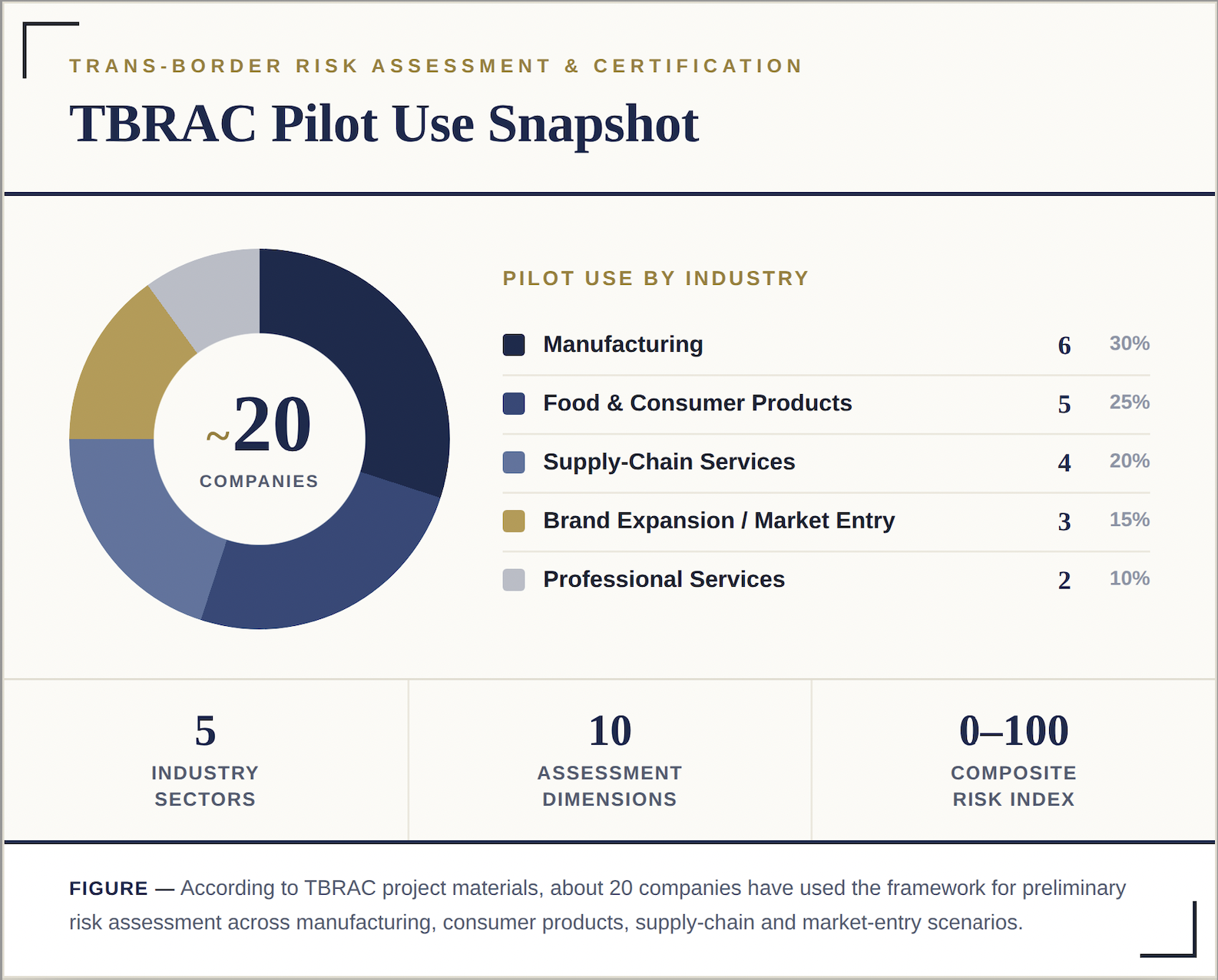
A new assessment system released this month is trying to move those questions forward. It is called Trans-Border Risk Assessment and Certification, or TBRAC, and it organizes U.S. market-entry risk into ten dimensions and roughly 100 standardized criteria. The goal, in plain terms, is to give companies—and, increasingly, the U.S. local governments competing for their investment—one structured view of exposure, before sites are picked, contracts signed or local hires made.
Around 20 companies have used or begun using TBRAC so far. They span manufacturing, food and consumer goods, supply-chain services, brand expansion and professional services. Most are coming into the U.S. from overseas. A meaningful share are Chinese companies working through a market whose regulatory and political backdrop has become harder to read by the quarter.
TBRAC was built by Yanyu Zhang, an entrepreneur and author based in the San Francisco Bay Area. Before TBRAC, she founded Accounting Island, a finance and business training platform in China. She published the methodology behind the system in a 2025 book, Trans-Border Risk Assessment and Certification for Chinese Companies Exploring U.S. Market Entry, and spent the past year turning the book’s framework into a tool that companies can actually run rather than read.
“Almost all of the damage I see happens because the wrong question got asked too late,” Zhang said. “TBRAC is not legal advice. It does not replace lawyers, accountants, regulators. What it does is help a company figure out which conversations it actually needs to have, and in what order.”
Ten dimensions, one picture
Cross-border risk usually arrives in pieces. A law firm covers regulatory exposure. An accountant handles tax and audit. A consultant runs site selection. A communications team thinks about brand. Each one looks competent on its own. The trouble is that no one is paid to look at the whole, and the gaps between them are where most of the avoidable problems live.
TBRAC pulls those threads into a single assessment built around ten dimensions: regulatory scrutiny; political and geopolitical exposure; intellectual property; data security and privacy; reputational risk; market access; supply-chain vulnerability; financial soundness; national security and technology transfer; and corporate governance and transparency.
Some of those dimensions are familiar territory for in-house counsel. Others are not. Reputational risk, for example, has long been treated as a communications problem to be managed after the fact rather than a structural risk to be diligenced beforehand. Corporate governance and transparency tend to be reviewed only when a specific transaction forces the question. Supply-chain vulnerability has, in the last few years, gone from a procurement issue to a regulatory one. TBRAC’s argument is that these now need to sit on the same page as the more traditional legal and tax questions, because they increasingly determine the same outcomes.
Each dimension breaks into standardized questions scored on a 0–10 scale, and the scores roll up into a composite risk index out of 100. The number by itself does not say much. What the system insists on is the evidence behind it: a specific regulatory filing, a hit on an entity list, an ownership document the company cannot fully explain, a tier-three supplier nobody has actually visited. The output is not a verdict. It is a map of where verdicts will eventually be needed.
That is, in practice, the most important design choice in TBRAC. It does not try to tell a company whether to enter the U.S. market. It tries to tell the company which parts of its own house will not stand up to scrutiny, and which conversations—with lawyers, lenders, regulators, partners or local officials—need to happen first.
Why now
The U.S. has not gotten harder in one direction. It has gotten harder in layers. State rules sit on top of federal rules. Industry licensing sits on top of data and privacy compliance. On top of that sit supply-chain documentation requirements, sanctions screening, and a foreign-investment review regime whose edges keep moving. Companies rarely fall on any single layer. They fall on the stack.
Several of the layers have moved noticeably in the last two years. Data localization and cross-border transfer rules have multiplied at the state level. Forced-labor enforcement has shifted the burden of proof toward importers. Outbound investment screening has begun to touch transactions that would not have drawn attention five years ago. None of these changes are unmanageable on their own. Taken together, they have raised the floor on what a foreign company is expected to know about its own operations before showing up in the U.S.
For Chinese companies the shift has been sharper. A consumer brand looking for U.S. distributors is in one position. A battery maker considering a Midwestern plant is in another. A software company hoping to raise from U.S. investors is in a third. TBRAC was deliberately built to treat those cases as different problems rather than rolling them into a single category called “Chinese companies entering the U.S.”
“Companies tend to understand their own business very well,” Zhang said. “What they often don’t understand is how that business looks from the outside—to a regulator, a bank, a city council, a reporter. TBRAC, in the end, is that outside view written down.”
The broader environment matters as well. Foreign direct investment into the United States has remained substantial, but its composition has shifted. More of the inbound capital comes attached to manufacturing footprints, supply-chain commitments and long-term operating presence rather than passive holdings. That shift has, in turn, raised the stakes on questions that used to be footnotes—where a component was actually fabricated, who holds an indirect minority stake three layers up, which data flows back to which jurisdiction. Companies that could once enter the U.S. as essentially commercial actors are increasingly expected to enter as institutional ones.
What it actually does
The assessment lives in the period before the expensive decisions.
A manufacturer weighing a U.S. plant might run it to pressure-test supply-chain documentation, ownership disclosure, data controls and community-engagement readiness before opening formal talks with a state economic development office. A consumer brand might run it to check whether its labeling, import paperwork and platform terms will survive contact with U.S. distributors and retailers. A technology company might run it before going out to investors, on the theory that it is cheaper to find a problem inside the company than to have a U.S. counsel surface it during diligence.
The format is closer to a structured diligence questionnaire than to a typical consulting report. Companies work through the ten dimensions with supporting documentation in hand—corporate records, supplier lists, data-handling policies, prior filings, customer contracts—and the system flags where the evidence is thin, where it conflicts, or where a piece of information that looks routine inside the company is likely to look unusual to an American counterpart. The deliverable is a scored profile plus a working list of items to address.
TBRAC’s materials describe one case in some detail. A manufacturer considering a U.S. facility used the system before moving to the next planning stage. The assessment did not replace the legal work or the site search. What it did was flag gaps—mainly in supplier traceability and ownership documentation—that the company was able to address quietly, before a public site announcement made the same gaps a matter of public record. The fix at that stage was a fraction of what it would have cost six months later.
Early users describe the value in similar terms. According to the project, the framework rarely reveals something a company has never thought about. What it reveals, more often, is what the company has thought about separately, in pieces, and never connected. The act of putting the ten dimensions on a single page, with evidence attached, is itself most of the work.
The system is also pitched at the other side of the table. American cities, counties and states compete hard for foreign investment, but local economic development teams rarely have the staff to evaluate complex ownership structures, supply-chain claims or sanctions exposure on their own. The result, in some cases, is that incentive packages move forward on the basis of pitches rather than diligence, and questions arrive only after the political commitments are made. TBRAC describes its role on that side of the table as a pre-entry screen, not a substitute for the formal due diligence that follows.
Not a CFIUS substitute
TBRAC is careful about what it is not. It is not a government approval. It is not a legal opinion. It is not a substitute for the Committee on Foreign Investment in the United States, the federal panel that screens certain foreign deals for national security concerns.
CFIUS, however, sees only a portion of the cross-border universe. A great deal of foreign investment never gets there, and a great deal of the real damage happens at the state and local level—in procurement decisions, in banking relationships, in insurance underwriting, in supplier audits, in community sentiment, in the local paper. Those are the layers TBRAC was built around. The system is designed to engage before any of them turns into a formal dispute or an enforcement letter, the point at which costs typically jump by an order of magnitude.
It is also designed to operate before the questions get political. A regulatory inquiry can be answered with documentation. A bank can be reassured with restructuring. A city council that has already taken a public position is harder to move. The earlier the conversation happens, in Zhang’s view, the more options remain on the table.
From book to system
March marks the point at which TBRAC stops being a book and starts being something companies can run. Zhang’s 2025 book, Trans-Border Risk Assessment and Certification for Chinese Companies Exploring U.S. Market Entry, set out the underlying methodology: how regulatory, supply-chain, data, governance and reputational risks interact for Chinese companies entering the U.S., and where the typical blind spots tend to sit. The book was written for a Chinese readership of executives, advisors and policy researchers who had begun to find the existing U.S.-entry literature either too legalistic to act on or too general to be useful. The current system turns that methodology into a working assessment—ten dimensions, scoring logic, document checklists and sample outputs.
Zhang said the next phase of the work focuses on expanding the criteria, refining the report formats, and building out case libraries for sectors the system has not yet covered in depth—life sciences, advanced materials and certain segments of digital services among them. The project also intends to release more public-facing material: self-assessment checklists, white papers, and shorter guides for companies and local officials who want a structured entry point into the topic without committing to a full review.
There is also a question of who else might use it. Banks doing onboarding diligence, insurers underwriting cross-border exposure, law firms running internal triage and economic development agencies evaluating inbound projects have each, separately, asked similar questions to the ones TBRAC formalizes. Whether the system becomes a shared vocabulary across those constituencies, or remains primarily a tool used by the companies themselves, will likely depend on how the next year of cases plays out.
Underneath all of it is an argument the system makes plainly. Finding a problem before market entry is, in nearly every case, a manageable cost: a revised document, a restructured holding, a swapped-out supplier. Finding the same problem after the investment is made, the staff is hired, the plant is built or the announcement is published is a different order of expense entirely, and often a different kind of problem altogether—one that involves lawyers, regulators and reporters rather than internal teams.
That is the gap TBRAC is trying to live in. Not the headline questions companies argue about in conference rooms, but the unglamorous, unevenly distributed pre-entry questions that, in Zhang’s telling, decide most of the outcomes anyway.
About TBRAC
Trans-Border Risk Assessment and Certification (TBRAC) is a ten-dimension risk assessment system that helps companies evaluate U.S. market-entry risks before major investment or operating decisions. It covers regulatory scrutiny; political and geopolitical risk; intellectual property; data security and privacy; reputational risk; market access; supply-chain vulnerability; financial and economic risk; national security and technology transfer; and corporate governance and transparency.
TBRAC was created by Yanyu Zhang, author of Trans-Border Risk Assessment and Certification for Chinese Companies Exploring U.S. Market Entry (2025).
BIMC
Boston International Media Consulting
email us here
Legal Disclaimer:
EIN Presswire provides this news content "as is" without warranty of any kind. We do not accept any responsibility or liability for the accuracy, content, images, videos, licenses, completeness, legality, or reliability of the information contained in this article. If you have any complaints or copyright issues related to this article, kindly contact the author above.
